
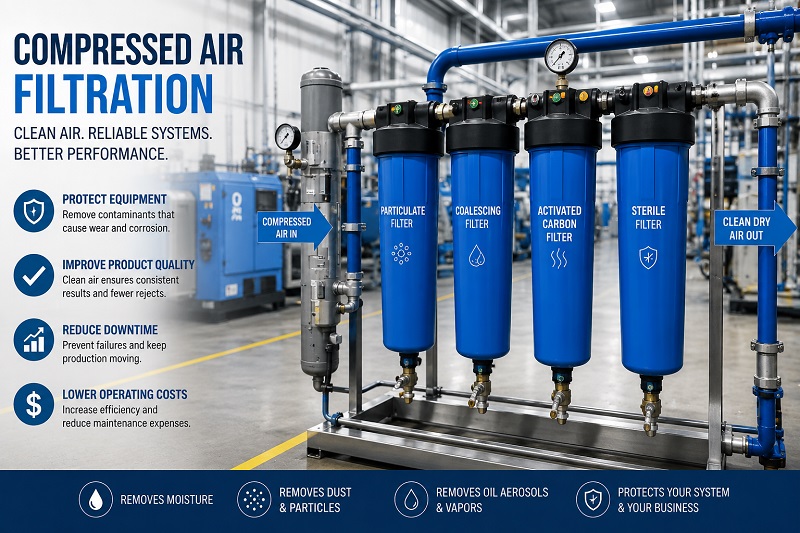
In many industrial environments, compressed air is often called the “fourth utility”, alongside electricity, water, and gas. That’s because modern manufacturing facilities depend heavily on compressed air systems to power pneumatic tools, production equipment, automation systems, and critical processing lines.
From food packaging plants and pharmaceutical facilities to automotive workshops and heavy manufacturing operations, compressed air plays a central role in keeping production moving efficiently.
However, there is one important factor that is often underestimated: air quality.
Compressed air may look clean, but in reality, untreated air often contains contaminants such as dust particles, oil aerosols, water vapour, and microorganisms. If these contaminants are not properly removed, they can cause serious damage to machinery, reduce product quality, increase maintenance costs, and lead to costly production downtime.
This is where compressed air filtration becomes essential.
A properly designed filtration system protects equipment, improves efficiency, ensures compliance with air quality standards, and helps businesses maintain consistent industrial productivity. In short, clean compressed air is not a luxury—it is a necessity.
What Is Compressed Air Filtration?
Compressed air filtration refers to the process of removing unwanted contaminants from compressed air before that air reaches machinery, pneumatic equipment, or production lines.
The purpose of air filtration systems is to ensure that compressed air remains clean, dry, and suitable for the specific industrial application.
Compressed air filters are designed to remove:
- Dust and solid particles
- Oil carryover and oil aerosols
- Moisture and water vapour
- Microorganisms and airborne contaminants
Without proper filtration, these contaminants travel through the entire compressed air system, affecting downstream equipment and production processes.
Think of filtration as the protective barrier between your compressor and your operation. Without that protection, contamination becomes inevitable.
Common Contaminants Found in Compressed Air
Even the cleanest-looking environment contains airborne contamination. Industrial compressors draw in large volumes of atmospheric air, and along with it come contaminants that can compromise system performance.
Dust and Solid Particles
Dust is one of the most common contaminants in compressed air systems. Industrial environments often contain:
- Dirt
- Rust particles
- Metal shavings
- Carbon deposits
- Debris from worn pipes
Once these particles enter the system, they can damage seals, clog valves, and reduce filtration efficiency.
In manufacturing environments where precision matters, even tiny solid contaminants can affect product quality.
Oil Carryover and Oil Aerosols
Many compressors use oil for lubrication, sealing, and cooling. During compression, small amounts of oil can enter the compressed air stream as vapour or aerosol particles.
These oil aerosols can:
- Contaminate products
- Damage pneumatic equipment
- Cause sticky residue in air lines
- Affect paint, coatings, and finishing processes
In industries such as food production or pharmaceuticals, oil contamination can create major compliance issues.
Moisture and Water Vapour
Atmospheric air naturally contains moisture. During compression, water vapour becomes concentrated.
As the compressed air cools, condensation forms, creating liquid water inside the system.
This leads to:
- Corrosion
- Rust
- Water in air lines
- Damaged valves and actuators
- Reduced machinery reliability
Moisture is one of the most destructive forms of contamination in compressed air systems.
Microorganisms and Airborne Contaminants
In sensitive industries, bacteria, mould spores, and other microorganisms can become serious concerns.
This is especially important in:
- Food processing
- Medical manufacturing
- Pharmaceutical production
- Beverage processing
In these environments, advanced filtration is essential for meeting strict air quality standards.
Why Poor Air Quality Reduces Industrial Productivity
Poor compressed air quality affects much more than the compressor itself. The impact spreads throughout the entire operation.
Reduced Pneumatic Equipment Performance
Pneumatic systems depend on clean, stable compressed air.
Contaminated air can cause:
- Sticking cylinders
- Slow actuator response
- Valve failures
- Inconsistent machine movement
When pneumatic equipment does not perform consistently, production efficiency suffers.
Lower Product Quality and Consistency
In industries where compressed air directly contacts products, contamination can ruin product quality.
Examples include:
- Oil contamination in food packaging
- Water contamination in spray painting
- Dust contamination in electronics manufacturing
Poor air quality often results in rejected products, rework, and customer complaints.
Shorter Equipment Lifespan
Air contaminants accelerate wear on:
- Seals
- Bearings
- Regulators
- Valves
- Cylinders
Over time, contamination causes equipment failure and increases replacement frequency.
Increased Production Downtime
A blocked filter, damaged valve, or contaminated line can shut down an entire production process.
Unexpected downtime leads to:
- Lost production hours
- Delayed deliveries
- Higher labour costs
- Lower profitability
Even a short interruption can be costly in high-output facilities.
Rising Maintenance Costs
Poor filtration increases maintenance requirements significantly.
Teams spend more time dealing with:
- Leak repairs
- Component replacement
- Filter blockages
- Moisture removal
- System cleaning
Over time, reactive maintenance becomes far more expensive than preventive filtration.
Types of Compressed Air Filters
Different contaminants require different filtration technologies.
Particulate Filters
Particulate filters remove solid contaminants such as:
- Dust
- Rust
- Dirt
- Pipe scale
These filters protect downstream components from abrasive damage.
Best for: General manufacturing, pneumatic systems, machinery protection.
Coalescing Filters
Coalescing filters remove:
- Oil aerosols
- Fine moisture droplets
- Sub-micron contaminants
They combine tiny liquid particles into larger droplets that can be drained from the system.
Best for: High-performance industrial air treatment systems.
Activated Carbon Filters
Activated carbon filters are used to remove:
- Oil vapours
- Odours
- Hydrocarbons
- Volatile organic compounds
These filters provide extremely clean air where purity matters.
Best for: Food, beverage, and sensitive manufacturing.
High-Efficiency Sterile Filters
These specialised filters remove ultra-fine contaminants including microorganisms.
They are commonly used where strict hygiene and sterility are required.
Best for:
- Pharmaceuticals
- Food processing
- Medical applications
- Biotechnology
How Filtration Improves System Efficiency
Effective filtration improves far more than air cleanliness.
Reduced Wear on Equipment
Clean air protects sensitive machinery from abrasion and contamination.
This means:
- Fewer breakdowns
- Less internal wear
- Longer equipment lifespan
Improved Energy Efficiency
Contaminated systems often force compressors to work harder.
Clean filters and air treatment systems reduce unnecessary energy demand.
This improves overall energy efficiency and lowers utility costs.
Stable Air Pressure
Good filtration helps maintain stable airflow throughout the system.
Stable air pressure improves machine performance and production consistency.
Minimise Pressure Drop
Pressure drop is one of the hidden costs in compressed air systems.
Poor filtration or clogged filters increase pressure drop, forcing compressors to consume more energy.
Condition | Impact |
Clean filter | Lower energy use |
Dirty filter | Higher pressure drop |
High pressure drop | Increased running costs |
Even small pressure drops can significantly increase electricity consumption.
Extended Maintenance Intervals
Clean compressed air means equipment stays cleaner for longer.
This allows maintenance teams to extend service intervals and reduce emergency repairs.
Signs Your Compressed Air System Needs Better Filtration
Your system may already be showing warning signs.
Watch for:
- Frequent equipment failures
- Water in air lines
- Rust inside piping
- Poor product quality
- Increased maintenance calls
- Rising energy bills
- Pressure fluctuations
- Sluggish pneumatic equipment
If multiple symptoms appear, filtration may be inadequate or overdue for maintenance.
How to Choose the Right Air Filtration System
Not every facility needs the same filtration setup.
The right system depends on several factors.
Required Air Purity Level
Different industries have different air quality requirements.
Food and pharmaceutical facilities require much higher purity than general manufacturing.
Operating Pressure
Filter selection must align with compressor operating pressure and system design.
Undersized filters create unnecessary pressure loss.
Flow Rate
Your filtration system must support required airflow without restricting performance.
Flow rate is critical for high-demand operations.
Industry Application
Consider the environment and process.
Ask:
- Is air contacting products?
- Is sterility required?
- Are oil-free processes necessary?
Maintenance Requirements
Choose filters that align with your maintenance capabilities.
Some filters require more frequent servicing than others.
Regulatory Compliance
Industries such as medical, food, and pharmaceutical production must comply with strict air quality standards.
Filtration systems should support compliance requirements.
Benefits of Investing in Quality Compressed Air Filters
Investing in high-quality compressed air filters delivers measurable long-term value.
Key benefits include:
- Higher productivity
- Better product quality
- Lower maintenance costs
- Reduced downtime
- Longer equipment lifespan
- Improved energy efficiency
- Better machinery protection
- Greater system reliability
For many businesses, the cost of poor filtration far exceeds the cost of proper filtration.
Compressed air filtration should never be treated as optional in industrial environments.
Compressed air may be invisible, but contamination problems quickly become visible through equipment failures, product defects, rising maintenance costs, and reduced operational efficiency.
By investing in the right air filtration systems, businesses can protect valuable machinery, maintain product quality, reduce production downtime, and improve long-term profitability.
Whether you operate a manufacturing plant, packaging facility, workshop, or processing environment, clean compressed air is essential for reliable performance and sustainable growth.
Need Expert Advice on Compressed Air Filtration?
Choosing the right compressed air filtration system can make a major difference to equipment reliability, air quality, and operating costs.
Capstone Engineering provides expert guidance on compressed air filtration, compressed air filters, and complete industrial air treatment solutions tailored to your operational requirements.
Visit our contact page to speak with our team about selecting the right filtration solution for your compressed air system.
Frequently Asked Questions
1. What is compressed air filtration?
Compressed air filtration is the process of removing contaminants such as dust, oil aerosols, water vapour, and microorganisms from compressed air before it reaches machinery, pneumatic equipment, or production lines. It helps maintain clean air and protects industrial systems from contamination-related damage.
2. Why is compressed air filtration important in industrial environments?
Compressed air filtration is important because contaminated air can damage equipment, reduce product quality, increase maintenance costs, and cause production downtime. Clean compressed air improves efficiency, reliability, and operational performance.
3. What contaminants are commonly found in compressed air systems?
Common contaminants include dust particles, rust, oil carryover, oil aerosols, water vapour, condensate, bacteria, and airborne microorganisms. These contaminants enter the system through atmospheric intake and compressor operation.
4. How does poor compressed air quality affect machinery?
Poor air quality can cause corrosion, clogged valves, seal damage, pressure fluctuations, and increased wear on pneumatic equipment. Over time, this reduces equipment lifespan and increases repair costs.
5. What are the main types of compressed air filters?
The main types are particulate filters, coalescing filters, activated carbon filters, and sterile filters. Each filter is designed to remove specific contaminants based on the required air purity level.
6. Can compressed air filtration improve energy efficiency?
Yes. Proper filtration reduces pressure drop, improves airflow, and prevents compressors from working harder than necessary. This lowers energy consumption and reduces operating costs.
7. What are signs that a compressed air system needs better filtration?
Common warning signs include water in air lines, frequent equipment failures, poor product quality, rising energy bills, increased maintenance, and unstable air pressure.
8. How often should compressed air filters be replaced?
Filter replacement depends on operating conditions, airflow demand, contamination levels, and manufacturer recommendations. Regular inspections help determine the correct replacement schedule.