
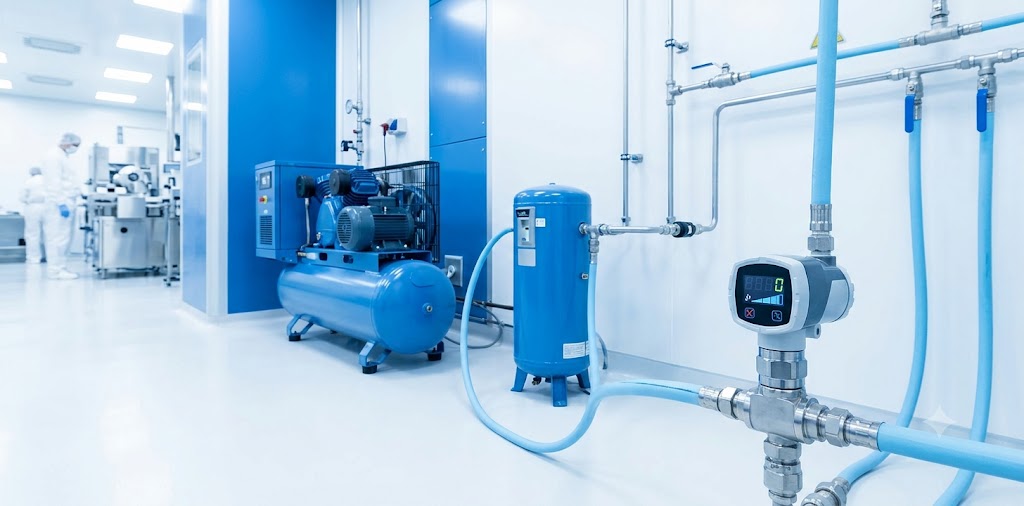
Moisture is an unavoidable consideration whenever atmospheric air is compressed. Capstone Engineering helps South African facilities understand and manage this moisture as part of the complete compressed-air system. The compressed air dew point indicates the temperature at which water vapour may begin to condense under stated pressure conditions, helping operators assess whether liquid water could form inside pipework, equipment or production processes.
Controlling moisture requires more than installing a filter or draining an air receiver. Facilities must understand pressure, temperature, airflow, ambient conditions and the lowest temperature the compressed air will encounter.
What Is Dew Point?
Dew point is the temperature at which water vapour in a gas begins to condense into liquid water at a stated pressure. When air cools to its dew-point temperature, it can no longer retain all its water vapour in gaseous form.
Dew point is different from relative humidity. Relative humidity describes how close the air is to saturation at its current temperature. Because warmer air can hold more water vapour than cooler air, relative humidity changes when the temperature changes, even if the actual quantity of moisture remains constant.
Dew point provides a more direct indication of the amount of water vapour present. A lower dew point generally indicates drier air, but it does not provide information about oil, particles or microorganisms.
What Is Pressure Dew Point in a Compressed-Air System?
Pressure dew point is the temperature at which water vapour begins to condense while the air remains at its operating pressure.
Pressure matters because compressed air contains a greater concentration of water vapour per unit volume than the atmospheric air entering the compressor. As the compressed air cools, its capacity to retain water vapour decreases, causing condensation.
A pressure dew-point reading is therefore meaningful only when the associated pressure is known. The same air sample may have a different dew-point value after it is expanded to atmospheric pressure.
For practical moisture control, the pressure dew point should be below the lowest temperature that the compressed air will experience. An appropriate operational margin should be established through system assessment rather than applying a universal figure.
Pressure Dew Point vs Atmospheric Dew Point
Atmospheric dew point refers to the condensation temperature measured or expressed at atmospheric pressure. Pressure dew point refers to the condensation temperature at the elevated pressure inside a compressed-air system.
These values are not interchangeable. When compressed air expands to atmospheric pressure, its moisture concentration per unit volume changes, and its atmospheric dew point will generally differ from its pressure dew point.
System records and dryer specifications should therefore state:
- Whether the value is a pressure or atmospheric dew point
- The pressure at which the measurement applies
- The measurement location
- Relevant air and ambient temperatures
- Whether the reading was continuous or taken as a periodic test
Without this context, two apparently different readings may not provide a meaningful comparison.
Why Pressure Dew Point Matters
If compressed air cools below its pressure dew point, water vapour begins to condense. Liquid water can then travel through pipework and reach tools, valves, cylinders, instruments or production equipment.
Possible consequences include:
- Internal pipework and pressure-vessel corrosion
- Damage to pneumatic tools and components
- Blocked or unreliable valves and controls
- Reduced lubricant effectiveness in air-powered equipment
- Product contamination
- Paint, coating or finishing defects
- Process instability
- Microbial growth in suitable conditions
- Ice formation in exceptionally cold areas or expansion points
The wider effects of compressed-air moisture on industrial equipment depend on the amount of moisture, system materials, operating conditions and sensitivity of the application.
How Moisture Enters and Moves Through a Compressed-Air System
A compressor draws in atmospheric air containing water vapour. The quantity entering the system changes with ambient temperature, humidity, season and location.
Compression reduces the air’s volume and increases the concentration of water vapour. The air also leaves the compression stage at an elevated temperature, allowing much of this moisture to remain as vapour initially.
As the air passes through an aftercooler, receiver and distribution pipework, it loses heat. Some vapour condenses into liquid water. A moisture separator can remove part of this condensed liquid, while automatic drains discharge it from separators, receivers and filters.
Separators and drains remove liquid water. They do not reduce the remaining water vapour to a controlled pressure dew point. That function is performed by an appropriately selected dryer.
South African operating conditions can vary considerably. Coastal humidity, hot inland summers, cold winter nights and exposed mining or agricultural pipework can create different moisture loads and condensation risks.
Outdoor distribution lines require particular attention because pipe temperatures may fall substantially overnight or during winter. Air that remains above its dew point inside a warm compressor room may condense further downstream when it enters colder pipework.
What Happens When the Dew Point Is Too High?
A dew point is too high when compressed air encounters temperatures below that dew point or when the remaining moisture exceeds the application’s air-quality requirements.
For example, air may leave a dryer without visible liquid water but still contain enough vapour to condense inside cold outdoor lines. A product-contact process may also require tighter moisture control than general workshop tools, even where condensation is not immediately visible.
The consequences of poor compressed air moisture control may not appear at once. Corrosion, contamination and component wear can develop gradually, making moisture problems difficult to trace without appropriate monitoring.
How Different Air Dryers Control Pressure Dew Point
Refrigerated air dryers
A refrigerated air dryer cools compressed air so that water vapour condenses. The liquid is then separated and discharged before the air is reheated or leaves the dryer.
Refrigerated dryers are widely used for general industrial applications with moderate dew-point requirements. Their suitability depends on the minimum system temperature and the air-quality needs of the process.
Desiccant air dryers
A desiccant air dryer passes compressed air through a material that adsorbs water vapour. This technology can achieve significantly lower pressure dew points than typical refrigerated systems.
Desiccant dryers may be used for instrument air, outdoor pipework exposed to low temperatures and moisture-sensitive processes. Their selection should consider purge losses or regeneration energy, maintenance requirements and the condition of upstream filtration.
Manufacturer specifications should be used to confirm achievable performance under the expected airflow, pressure, inlet temperature and ambient conditions. Capstone Engineering supplies industrial air dryers for different compressed-air applications.
How to Determine the Required Pressure Dew Point
The lowest achievable dew point is not automatically the most economical or practical target. Producing extremely dry air can require additional equipment, energy, maintenance and pressure management.
The required pressure dew point should be based on:
- The lowest ambient or pipe temperature
- Indoor and outdoor distribution conditions
- Product or process sensitivity
- Required compressed-air quality
- Operating pressure
- Airflow and demand variation
- Expansion points and pressure reduction
- Applicable specifications or standards
- Seasonal environmental conditions
- Consequences of moisture reaching the application
ISO 8573-1 classifies compressed-air purity in relation to particles, water and oil. Facilities using the standard should confirm the required classes for their specific application. Achieving a particular water class does not establish compliance for particles, oil or microorganisms.
How Pressure Dew Point Is Measured and Monitored
A dew-point sensor measures moisture-related conditions and calculates or detects the temperature at which condensation would occur.
Sensor location affects the usefulness of the reading. A sensor positioned immediately after a dryer may confirm dryer performance but may not detect moisture introduced through a bypass, wet receiver, cross-connection or downstream section.
Facilities may use continuous monitoring where air quality is critical or where conditions change frequently. Periodic testing may be adequate for less sensitive systems, provided testing reflects representative operating conditions.
Reliable readings require attention to:
- Measurement pressure
- Sensor location
- Sample flow
- Air and ambient temperature
- Oil or particle contamination
- Sensor response time
- Calibration status
- Manufacturer installation requirements
A contaminated, incorrectly installed or overdue sensor may provide misleading results. Calibration and maintenance should form part of the monitoring plan.
Common Mistakes in Compressed-Air Moisture Control
Common mistakes include:
- Selecting a dryer using nominal compressor capacity alone
- Ignoring elevated inlet or ambient temperatures
- Installing a dryer that cannot accommodate peak airflow
- Treating liquid removal as equivalent to vapour reduction
- Assuming filters control water vapour
- Leaving dryer bypass valves partially open
- Failing to maintain automatic drains
- Measuring dew point at an unrepresentative location
- Ignoring outdoor and seasonal temperatures
- Operating with excessive pressure loss
- Selecting an unnecessarily low dew point without evaluating costs
Filters can remove particles, oil aerosols and some liquid contamination according to their design, but standard filters do not remove water vapour. The distinction is explained further in Capstone Engineering’s guide to compressed-air filtration.
Improving Moisture Control Across the Entire System
Effective moisture control requires coordinated treatment rather than reliance on a single component.
The system should be reviewed from the compressor intake through to each critical point of use. This includes aftercoolers, separators, drains, receivers, dryers, filters, pipework and local treatment.
Air-storage equipment also affects moisture management. Appropriately configured pressure vessels and air receivers can support cooling, liquid separation and stable demand, but accumulated condensate must be discharged reliably.
Dryers, filters, separators and drains require regular inspection. Planned compressed-air system maintenance helps identify blocked filters, failed drains, fouled heat exchangers and declining dryer performance.
Practical Moisture-Control Considerations
System or application condition | Moisture-related risk | Dew-point consideration | Suitable control approach |
Indoor workshop pipework | Condensation in tools and local pipework | Consider the lowest indoor pipe temperature | Aftercooling, separation, drainage and a correctly sized dryer |
Outdoor distribution lines | Cooling below the pressure dew point during winter or overnight | Account for the lowest expected pipe temperature | Lower dew-point capability, insulated or redesigned pipework, drainage and monitoring |
General manufacturing | Corrosion, unreliable pneumatics and process disruption | Match the target to equipment and process requirements | Refrigerated or other suitable drying with filtration and drains |
Instrument air | Malfunction of sensitive valves and controls | Establish the requirement from instrument and process specifications | Appropriate dryer technology, filtration and dew-point monitoring |
Product-contact applications | Product contamination or quality problems | Determine the requirement through a process risk assessment | Validated treatment system with suitable drying, filtration and monitoring |
Cold environments | Liquid water or ice formation | Keep the pressure dew point below the lowest air temperature with an assessed margin | Lower-dew-point drying and monitoring at representative locations |
Long distribution systems | Additional cooling and condensate formation downstream | Assess conditions at the most vulnerable parts of the network | Correct dryer sizing, sloped pipework, drainage and downstream measurement |
Why Professional System Assessment Matters
Dryer sizing must account for actual airflow, system pressure, inlet temperature, ambient conditions and the required pressure dew point. Published nominal capacity may not represent performance under the facility’s operating conditions.
A professional assessment can identify moisture sources, cold sections, faulty drains, overloaded dryers, bypass leakage and unsuitable sensor locations. Capstone Engineering provides compressed-air consultation and turnkey system support for new installations and existing systems.
Establish the Correct Compressed Air Dew Point
The correct compressed air dew point depends on the application, required air quality, system pressure, airflow, inlet temperature, ambient conditions and the lowest temperature the compressed air will encounter. A suitable target should control condensation and process risks without imposing unnecessary treatment costs.
Improve Moisture Control with Capstone Engineering
For assistance assessing moisture problems, establishing an appropriate pressure dew point and selecting a suitable dryer, contact Capstone Engineering.
The team can assist with dryer sizing, filtration, separation, condensate drainage, air storage, pipework conditions, dew-point monitoring and upgrades to existing compressed-air systems.
Frequently Asked Questions
1. What is pressure dew point in a compressed-air system?
Pressure dew point is the temperature at which water vapour begins to condense while the compressed air remains at its stated operating pressure. The pressure must be specified for the reading to be interpreted correctly.
2. What is the difference between pressure dew point and atmospheric dew point?
Pressure dew point applies to air at elevated system pressure, while atmospheric dew point applies after the air is expressed or measured at atmospheric pressure. The values are not interchangeable because pressure affects moisture concentration.
3. What pressure dew point does an industrial facility need?
There is no universal target. The required pressure dew point depends on the process, air-quality specification, operating pressure and lowest temperature the compressed air will encounter. A suitable operational margin should be determined through system assessment.
4. How is compressed air dew point measured?
It is measured using a dew-point sensor installed directly in the system or connected through a controlled sampling arrangement. Location, pressure, temperature, contamination, sample flow and sensor calibration can affect the reading.
5. Can filters remove moisture from compressed air?
Filters and moisture separators can remove condensed liquid water when designed for that purpose, but standard filters do not remove water vapour. A suitable air dryer is required to reduce vapour and control pressure dew point.