
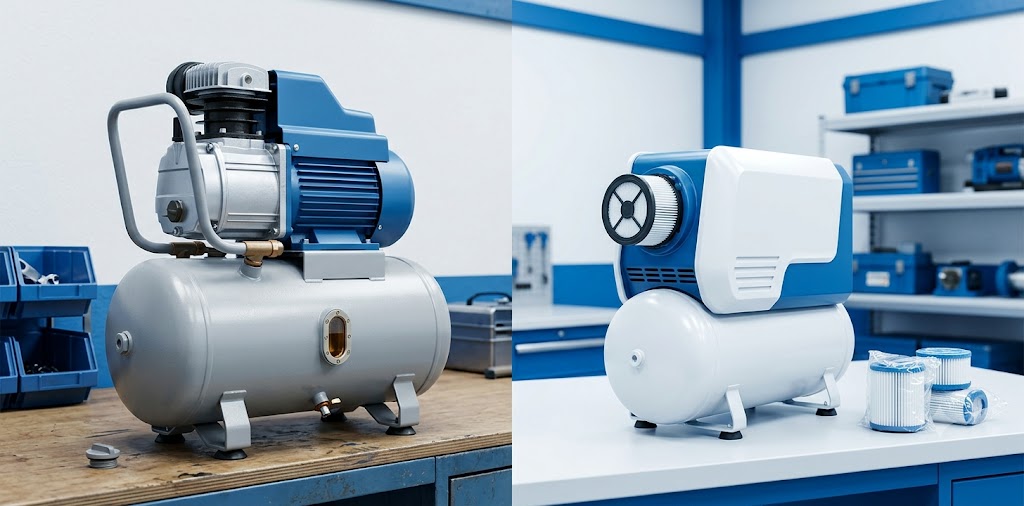
Choosing an industrial compressor that meets a facility’s air-quality, operational and budget requirements requires careful assessment. Capstone Engineering assists South African businesses with this decision. The central oil-free vs oil-lubricated air compressor difference is that an oil-free design does not introduce oil into the compression chamber, while a lubricated compressor uses oil for lubrication, sealing and cooling during compression.
Neither technology is automatically better for every application. The correct choice depends on the production process, contamination risk, operating pressure, airflow, working hours, maintenance resources and required compressed-air quality.
What Is an Oil-Free Air Compressor?
An oil-free air compressor compresses air without using oil inside the compression chamber. Depending on its design, it may use specialised coatings, water, alternative materials or precisely engineered components to manage friction and heat.
Oil-free does not mean that the entire machine contains no lubricants. Bearings, gearboxes or other components may still require lubrication, but these parts are separated from the compression chamber according to the equipment design.
Oil-free technology is available in different compressor configurations. The most appropriate option depends on the required pressure, airflow and duty cycle. Manufacturer specifications should always be reviewed before selecting equipment for continuous industrial use.
An oil-free compressor reduces the risk of lubricant entering the compressed-air stream at the compression stage. This can be important where compressed air contacts products, packaging, instruments or sensitive production equipment.
What Is an Oil-Lubricated Compressor?
An oil-lubricated compressor introduces oil into the compression process to lubricate moving components, assist with sealing and remove heat. The oil is subsequently separated from the compressed air before it leaves the compressor.
This approach is commonly used in industrial rotary screw compressors and many piston compressor configurations.
Oil lubrication can support reliable operation under demanding conditions, but some residual oil may remain in the air stream. Appropriate separators, filters and other treatment equipment are therefore required when the application has defined air-quality limits.
Oil-lubricated compressors are frequently used for general manufacturing, workshops, mining, agriculture and industrial processes where properly treated compressed air meets the application’s requirements.
Oil-Free vs Oil-Lubricated Air Compressor: Key Differences
The choice involves more than whether oil is present in the compression chamber. It affects equipment cost, maintenance planning, contamination control and the design of the complete compressed-air system.
Oil-free compressors may be selected when even a small risk of oil contamination could affect product quality, process integrity or regulatory compliance. Oil-lubricated equipment may provide a practical solution where the application permits treated air containing oil levels within a specified limit.
The decision must be based on a documented understanding of the air’s intended use. Businesses can compare options across Capstone Engineering’s industrial compressor range, but model selection should follow a proper assessment.
Air Quality and Contamination Risks
An oil-free compression chamber reduces one source of oil contamination, but it does not automatically produce air that is free from every contaminant.
Atmospheric air entering any compressor may contain:
- Dust and other particles
- Water vapour
- Hydrocarbon vapours
- Microorganisms
- Fumes from nearby operations
- Contaminants drawn in through an unsuitable intake location
Compression can concentrate some of these contaminants. Moisture can also condense as compressed air cools. An oil-free system may therefore still require filtration, drying, drainage and suitable condensate management.
ISO 8573-1 classifies compressed-air purity according to particles, water and oil. If Class 0 is specified for a particular contaminant, it represents a user-defined requirement that is stricter than Class 1 and agreed between the equipment user and supplier. It should not be interpreted as a universal requirement or as proof that the air contains absolutely no contaminants of any kind.
The required quality class should be established through the facility’s process requirements and risk assessment.
Performance, Durability and Duty-Cycle Considerations
Both compressor types can provide reliable industrial service when correctly designed, sized, installed and maintained. Reliability cannot be determined by lubrication type alone.
Important performance considerations include:
- Required airflow at minimum, average and peak demand
- Operating pressure at the point of use
- Daily and annual working hours
- Continuous or intermittent duty
- Ambient temperature and ventilation
- Allowable noise levels
- Expected production growth
- Backup and redundancy requirements
Oil helps lubricated compressors seal internal clearances and manage heat. Oil-free systems use different engineering methods to perform these functions and may operate at different internal temperatures.
Noise also varies according to compressor technology, speed, enclosure and installation. It should be assessed using the manufacturer’s data for the specific model rather than general assumptions about oil-free or lubricated equipment.
Purchase Price, Maintenance and Operating Costs
Initial equipment cost is only one part of the compressor total cost of ownership. Installation, electricity, servicing, air treatment, replacement parts and downtime should also be considered.
An oil-free air compressor may have a higher initial cost because of its specialised compression technology. However, it may reduce specific contamination risks and eliminate some oil-related treatment requirements.
A lubricated air compressor may have a lower purchase price for a comparable industrial duty. It will require scheduled oil, filter and separator servicing, together with suitable downstream treatment where defined air quality must be maintained.
Neither technology is always more energy efficient. Energy use depends on factors including compressor design, motor efficiency, control method, pressure setting, load profile, system leakage and correct sizing.
Following the manufacturer’s maintenance schedule is essential for both types. Professional industrial compressor maintenance can help protect reliability and identify declining performance before it causes wider production problems.
Comparison Table
Consideration | Oil-Free Air Compressor | Oil-Lubricated Compressor |
Compression method | No oil is introduced into the compression chamber, although other components may require lubrication | Oil supports lubrication, sealing and cooling during compression |
Air-quality considerations | Reduces the risk of compressor lubricant entering the air stream | Residual oil must be controlled through separation and treatment |
Initial investment | May involve a higher initial equipment cost | Often offers a lower initial cost for comparable general industrial duties |
Maintenance requirements | Requires servicing according to its specific mechanical and treatment design | Requires scheduled oil, filter and separator maintenance |
Typical applications | Contamination-sensitive production and processes requiring tightly controlled oil levels | Workshops, manufacturing, mining, agriculture and general industrial use |
Duty-cycle suitability | Depends on the model, design and manufacturer’s specified duty cycle | Commonly available for intermittent and continuous industrial duties |
Contamination risk | Removes oil injection from the compression chamber but not atmospheric particles, moisture or external contaminants | Has an inherent lubricant contamination risk that must be assessed and controlled |
Air-treatment requirements | May still require particle filtration, drying and condensate management | Usually requires filtration, separation, drying and condensate management based on the application |
Total cost considerations | Consider purchase cost, energy use, specialised servicing and contamination-risk reduction | Consider purchase cost, oil and separator changes, treatment equipment, energy use and maintenance |
Which Industries Typically Require Oil-Free Compressed Air?
Oil-free compressed air may be required where contamination could affect products, processes, testing results or regulatory compliance.
Relevant applications may include:
- Direct product-contact points in food and beverage production
- Certain pharmaceutical manufacturing processes
- Electronics and precision component production
- Laboratory and analytical applications
- Chemical processing with strict purity requirements
- Sensitive coating, painting or packaging operations
- Medical or breathing-air systems designed for their specific standards
Not every application within these industries has the same requirement. A food production facility, for example, may use different air-quality specifications for direct product contact, packaging machinery and workshop tools.
The decision should be supported by a process-level risk assessment rather than an industry label alone.
When Is an Oil-Lubricated Compressor More Suitable?
An oil-lubricated compressor may be suitable where the application does not require oil-free compression and properly treated air can meet the specified quality level.
Typical applications include:
- Pneumatic workshop tools
- General manufacturing machinery
- Mining equipment
- Agricultural operations
- Vehicle maintenance facilities
- Material handling systems
- Non-sensitive process automation
Lubricated compressors are available across a wide range of outputs and configurations. They can offer a practical balance of purchase cost, performance and maintainability when contamination risks are understood and appropriately managed.
Downstream filtration should not be assumed to make every lubricated system suitable for highly sensitive production. The complete design must be evaluated against the actual quality requirement.
Factors to Consider Before Choosing a Compressor
Before purchasing an air compressor in South Africa, assess:
- The intended use of the compressed air
- Whether air contacts products or critical surfaces
- Required ISO 8573-1 purity classes, where applicable
- Minimum, average and maximum airflow
- Required operating pressure
- Duty cycle and working hours
- Compressor room temperature and ventilation
- Available electrical supply
- Existing receiver and pipework capacity
- Acceptable contamination risk
- Maintenance skills and service access
- Energy consumption and lifecycle costs
- Future production requirements
Selecting an unsuitable compressor can create product-quality issues, excessive maintenance, wasted energy, insufficient pressure or unnecessary capital expenditure.
A professional review of compressor selection and system design through consultation and turnkey project support provides a more dependable basis for investment.
Why Air Treatment Is Still Important
The compressor is only one part of the compressed-air system. Receivers, filters, dryers, drains, pipework and point-of-use treatment all influence delivered air quality.
A suitable compressed-air dryer helps control moisture and the associated risks of corrosion, microbial growth, frozen lines or process disruption. Particle and coalescing filters may also be required, depending on the compressor type and purity specification.
Condensate must be collected and managed appropriately. In lubricated systems, compressor condensate may contain oil and require suitable separation and disposal.
Treatment equipment must be correctly sized for flow, pressure, inlet temperature and environmental conditions. Poorly selected equipment can cause excessive pressure loss or fail to deliver the required air quality.
Why Professional Compressor Assessment and Sizing Matter
A compressor should be selected as part of a complete system rather than as an isolated machine.
Oversizing can increase capital costs and cause inefficient operation. Undersizing can lead to inadequate pressure, excessive running hours and accelerated wear. The assessment should examine current demand, peak loads, pressure losses, leakage, air quality, storage capacity and future expansion.
For multi-compressor installations, sequencing and control strategy are also important. Different compressor technologies may be combined to handle base demand, variable loads or critical backup requirements.
Choose the Correct Compressor for Your Application
The oil-free vs oil-lubricated air compressor decision should be guided by the facility’s production process, contamination risk, air-demand profile, required pressure, operating hours and future requirements. Oil-free technology can be appropriate for sensitive applications, while an oil-lubricated compressor may offer a practical and cost-effective solution for many general industrial duties.
Discuss Your Compressed-Air Requirements with Capstone Engineering
For assistance assessing your application, determining the required air-quality level and comparing compressor technologies, contact Capstone Engineering.
The team can help calculate airflow and pressure requirements, select the correct compressor size, plan filtration, drying and air storage, and evaluate maintenance needs and long-term ownership costs.
Frequently Asked Questions
1. What is the main difference between an oil-free and an oil-lubricated air compressor?
An oil-free compressor does not introduce oil into the compression chamber. An oil-lubricated compressor uses oil for lubrication, sealing and cooling during compression. Other parts of an oil-free machine may still require lubrication, depending on its design.
2. Does an oil-free air compressor produce completely contaminant-free air?
No. Oil-free compression reduces the risk of compressor lubricant entering the air stream, but intake air can still contain particles, moisture, hydrocarbon vapours and other contaminants. Filtration, drying and condensate management may still be necessary.
3. Which industries may require oil-free compressed air?
Certain food, beverage, pharmaceutical, electronics, laboratory and precision manufacturing processes may require oil-free compressed air. The requirement depends on the application, product-contact risk, quality standard and facility risk assessment.
4. Is an oil-lubricated compressor cheaper to operate?
Not necessarily. It may have a lower initial cost, but operating expenses depend on energy use, servicing, oil and separator replacement, treatment requirements and working hours. Total ownership costs should be compared using actual operating conditions.
5. How can a business determine which compressor type it needs?
The business should assess how the air is used, the required purity level, contamination risks, airflow, pressure, duty cycle, operating environment and future demand. A professional compressed-air assessment can then compare suitable oil-free and oil-lubricated options.