
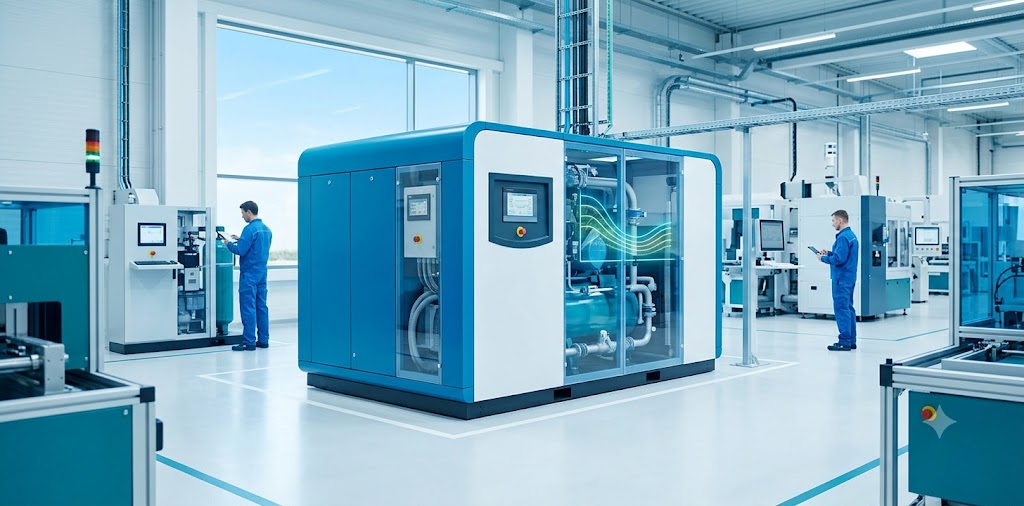
Controlling compressed-air energy consumption is an important consideration for any facility that relies on compressed air throughout its operations. Capstone Engineering helps South African businesses assess compressor requirements based on how air is actually used. A variable speed drive air compressor adjusts its motor speed as compressed-air demand changes, potentially reducing unnecessary power consumption during periods of lower demand.
However, variable speed drive technology is not automatically the best option for every facility. The value of the investment depends on factors such as demand fluctuations, working hours, operating pressure, compressor sizing and the condition of the wider compressed air system.
What Is a Variable Speed Drive Air Compressor?
A variable speed drive air compressor uses an electronic drive to regulate the speed of the compressor motor. Instead of operating continuously at a fixed motor speed, the compressor increases or decreases its output according to the volume of compressed air required by the facility.
Variable speed drive technology is commonly used with industrial rotary screw compressors, which are designed for applications requiring a reliable and continuous compressed-air supply.
When demand rises, the motor accelerates to produce more compressed air. When demand falls, the motor slows down. This enables the compressor to match its output more closely to actual consumption.
A VSD air compressor may be suitable for:
- Manufacturing facilities with changing production schedules
- Workshops using pneumatic equipment intermittently
- Processing plants with variable production loads
- Mining operations with shifting equipment requirements
- Agricultural facilities with seasonal or irregular demand
- Facilities operating multiple production lines
- Businesses experiencing significant differences between shifts
The technology is particularly relevant where compressed-air consumption changes frequently rather than remaining constant throughout the day.
How Does a VSD Air Compressor Work?
A VSD compressor monitors system pressure through sensors connected to its control system. When pressure begins to fall because more compressed air is being consumed, the drive increases the motor speed. When demand decreases and system pressure rises, the drive reduces motor speed and compressor output.
This process helps maintain pressure within a relatively narrow operating range.
A conventional fixed-speed air compressor generally operates at its rated motor speed while loaded. Once the required pressure is reached, it may continue running in an unloaded state until demand increases or the compressor stops. Although unloaded operation produces little or no useful compressed air, the compressor continues to consume energy.
A variable speed system can reduce the time spent running unloaded by adjusting output before unloading becomes necessary. The actual result will depend on the compressor model, its operating range, system configuration and demand profile.
Fixed-Speed vs Variable-Speed Air Compressors
The main difference between fixed-speed and variable-speed compressors is how they respond to changes in demand.
Fixed-speed air compressor
A fixed-speed compressor runs its motor at a constant speed when producing compressed air. It is often well suited to applications with stable, predictable demand close to the compressor’s rated output.
Fixed-speed units may offer:
- A lower initial purchase price
- Straightforward operation
- Suitability for continuous base-load applications
- Simpler control arrangements
- Reliable performance under steady demand
VSD air compressor
A VSD air compressor changes motor speed to match output with changing air requirements. It is generally more suitable for facilities with fluctuating demand.
Potential advantages include:
- Reduced unloaded running
- Closer matching of output to demand
- More consistent system pressure
- Lower starting current through soft-start operation
- Less frequent full-load and unload cycling
- Reduced noise during periods of lower output
Businesses comparing equipment can review Capstone Engineering’s complete range of compressor solutions as part of the selection process.
Key Benefits of Variable Speed Drive Technology
Potential reduction in energy consumption
Compressed-air demand and compressor energy consumption are closely connected. If a compressor regularly produces more air than the facility requires, some energy is used without delivering productive output.
A correctly sized variable speed drive air compressor can reduce this mismatch by lowering motor speed during periods of reduced demand. The potential savings depend on the extent and frequency of these variations.
A VSD compressor should not be considered a substitute for correcting leaks, excessive pressure settings, poorly sized pipework or inappropriate air use. Improving industrial energy efficiency requires reviewing the complete system.
More consistent system pressure
Fixed-speed compressors often operate across a wider pressure band as they load and unload. A VSD compressor can adjust its output more gradually, helping maintain pressure closer to the required set point.
Consistent pressure may support reliable operation of pneumatic machinery, instruments and production equipment. It can also reduce the temptation to operate the system at an unnecessarily high pressure to compensate for pressure fluctuations.
Reduced mechanical and electrical stress
Variable speed drives normally provide a soft-start function. Instead of drawing a high starting current immediately, the motor accelerates progressively.
This can reduce electrical demand during start-up and limit mechanical stress on belts, couplings and other components. A VSD system may also reduce frequent starting, stopping, loading and unloading when demand changes regularly.
Lower noise during reduced demand
When a VSD compressor operates below maximum motor speed, it may generate less noise than it does at full output. This can be beneficial in workshops and production areas where the compressor is installed near occupied working spaces.
Noise levels still depend on the compressor enclosure, installation, room construction, ventilation and operating speed.
When Is a VSD Air Compressor Worth the Investment?
A VSD compressor is most likely to provide value when compressed-air requirements vary meaningfully during operating hours.
Examples include facilities where:
- Different machines operate at different times
- Air demand changes between production shifts
- Pneumatic tools are used intermittently
- Production volume changes throughout the day
- Multiple processes create irregular demand peaks
- Weekend demand is substantially lower than weekday demand
- The existing compressor spends significant time running unloaded
Long operating hours can strengthen the financial case because any reduction in avoidable compressor energy consumption is repeated over more hours. However, actual air-demand data should be reviewed before selecting equipment.
A professional air assessment can identify demand patterns, pressure fluctuations, unloaded running and peak-flow requirements. Capstone Engineering provides consultation and turnkey project support for both single-compressor and multi-compressor installations.
When Might a Fixed-Speed Compressor Be More Suitable?
A fixed-speed compressor may be more appropriate when demand is stable and remains close to the compressor’s rated capacity for long periods.
This may apply to:
- Continuous production processes with consistent air consumption
- Base-load compressors in multi-compressor installations
- Facilities with limited operating hours
- Applications with minimal variation between minimum and maximum flow
- Projects where the lower initial purchase cost is a major consideration
A VSD unit operating continuously near its maximum output may offer limited efficiency advantages over a properly sized fixed-speed compressor. In some multi-compressor systems, an effective arrangement is to use fixed-speed compressors for the base load and a VSD compressor to manage fluctuating demand.
Factors to Consider Before Selecting a VSD Compressor
Selecting an industrial air compressor should involve more than comparing motor ratings and purchase prices. Important considerations include the following.
Compressor duty cycle
The duty cycle indicates how frequently and for how long the compressor must operate. Facilities with long working hours require equipment designed for the expected operating conditions.
Minimum and maximum flow requirements
Both the lowest and highest compressed-air requirements should be established. The selected VSD compressor must be able to regulate effectively across the required flow range.
If demand regularly falls below the compressor’s minimum controllable output, the unit may still need to unload or stop.
Required operating pressure
The compressor should provide sufficient pressure at the point of use after allowing for pressure losses through pipework, filters, dryers and other system components. Operating at a higher pressure than necessary can increase energy consumption.
Air quality and drying requirements
Some production processes require clean, dry compressed air. The compressor selection should therefore be considered alongside filtration, condensate management and appropriate compressed-air dryer solutions.
Air receiver capacity
An appropriately sized air receiver can help manage short demand peaks, stabilise pressure and reduce unnecessary compressor cycling. Existing receiver capacity should be reviewed as part of the complete compressed air system.
Compressor room conditions
High ambient temperatures, restricted ventilation, dust and inadequate service access can affect reliability and maintenance. The compressor room must provide sufficient cooling airflow and comply with the equipment manufacturer’s installation requirements.
Maintenance and lifecycle requirements
A VSD compressor includes electronic control equipment that must be protected from heat, dust, moisture and unstable electrical conditions. Maintenance should cover the compressor, motor, drive, filters, cooling system and air-treatment equipment.
Planned compressor maintenance services can support reliability and help identify system issues before they cause unplanned downtime.
Technical teams can also consult available product catalogues and specifications when comparing equipment.
Understanding the Potential Return on Investment
The purchase price is only one component of compressor ownership. A realistic evaluation should consider:
- Initial equipment and installation costs
- Electricity consumption
- Operating hours
- Expected demand variation
- Maintenance costs
- Air-treatment requirements
- Downtime risk
- Expected equipment lifespan
- Future production requirements
The potential return on investment can be estimated by comparing the projected lifecycle cost of a fixed-speed compressor with that of a VSD alternative.
A facility should avoid applying a universal energy-saving percentage. Results vary according to the air-demand profile, compressor size, pressure setting, system leakage, control arrangement and condition of the installation.
Reviewing actual demand data provides a more reliable basis for calculating whether the additional purchase cost may be recovered through lower operating costs.
Why Professional Compressor Assessment and Sizing Matter
An oversized compressor can operate inefficiently, even when equipped with variable speed technology. An undersized compressor may run continuously at maximum output without maintaining the required pressure.
Professional assessment should consider:
- Current and planned air-consuming equipment
- Peak and average compressed-air demand
- Minimum system demand
- Required pressure at each point of use
- Shift patterns and annual operating hours
- Leakage and artificial demand
- Air receiver capacity
- Pipework pressure losses
- Air quality requirements
- Expansion plans
- Backup and redundancy requirements
For multi-compressor installations, the assessment should also consider compressor sequencing. Correct control can prevent several units from running partially loaded or working against one another.
Choose the Right Compressor for Your Air-Demand Profile
A variable speed drive air compressor can be a worthwhile investment when a facility has fluctuating compressed-air demand and sufficient operating hours to justify the higher initial cost. A fixed-speed unit may remain the better choice for stable, continuous demand or as a base-load compressor within a larger installation.
The correct decision depends on the facility’s actual air-demand profile, required operating pressure, working hours, system condition and future requirements.
Evaluate Your Compressed-Air Requirements with Capstone Engineering
For support comparing fixed-speed and variable-speed options, sizing the correct compressor and planning an efficient industrial compressed air system, contact Capstone Engineering. The team can help assess your operational requirements and recommend an appropriate configuration for a single-compressor or multi-compressor installation.
Frequently Asked Questions
1. How much energy can a VSD air compressor save?
There is no universal saving percentage that applies to every installation. Potential savings depend on demand variation, operating hours, compressor sizing, pressure settings, system condition and the amount of unloaded running in the current system. An air-demand assessment is the most reliable way to estimate potential savings.
2. Is a VSD compressor suitable for continuous operation?
Yes, a VSD compressor can operate continuously if it is correctly selected and maintained. However, if demand remains consistently close to full compressor output, a fixed-speed compressor may provide similar performance at a lower initial cost. The facility’s demand profile should guide the decision.
3. What is the difference between a fixed-speed and VSD compressor?
A fixed-speed compressor runs at a constant motor speed while producing compressed air. A VSD compressor adjusts motor speed according to demand. Fixed-speed units are often suited to stable loads, while VSD compressors are commonly used where consumption changes throughout the operating period.
4. Does a VSD air compressor require specialised maintenance?
The core compressor requires many of the same routine maintenance procedures as a fixed-speed unit, including filter, lubricant and separator servicing where applicable. The variable speed drive and electronic controls must also be inspected and protected from excessive heat, dust, moisture and poor electrical conditions.
5. How can a business determine whether a VSD compressor is worth the investment?
The business should review actual air-demand data, operating hours, required pressure, current unloaded running, energy consumption, system leaks and future production needs. A professional compressed-air assessment can then compare the expected purchase, operating and lifecycle costs of fixed-speed and variable-speed options.