
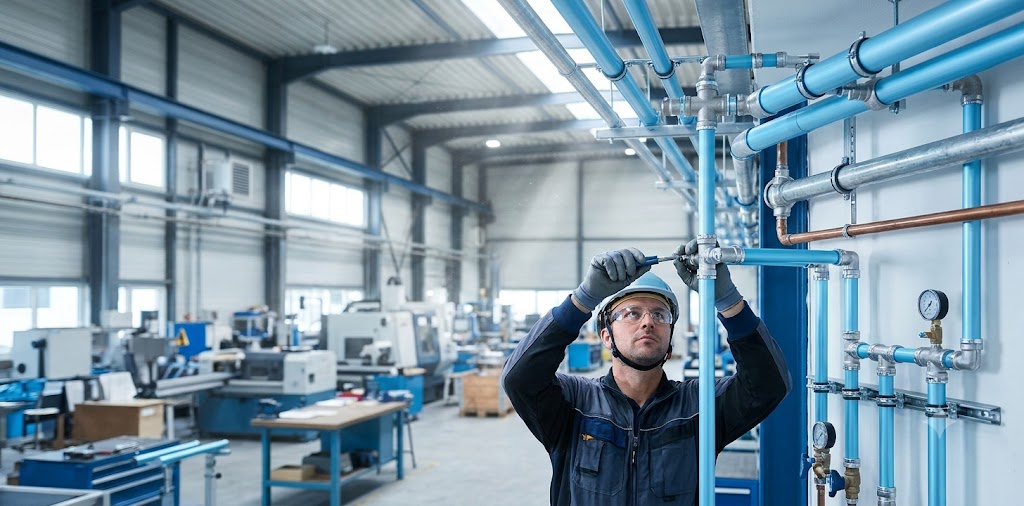
Pipe material affects pressure stability, delivered air quality, system safety, maintenance requirements and long-term operating costs. Capstone Engineering helps South African facilities evaluate these factors when planning compressed air piping. The complete air compressor piping system must be considered because choosing material based only on its initial price can result in corrosion, leakage, restrictions or costly modifications later.
No single piping material is best for every facility. Selection should reflect airflow, pressure, temperature, air-quality requirements, environmental exposure, layout and future production plans.
Why Compressed Air Piping Material Matters
Compressed-air pipework carries air from the compressor and treatment equipment to each point of use. Its internal condition, diameter, fittings and layout influence how reliably that air reaches production equipment.
An unsuitable compressed-air pipe material may contribute to:
- Excessive pressure loss
- Internal or external corrosion
- Air contamination
- Leaks at joints and fittings
- Condensate accumulation
- Difficult maintenance
- Unsafe operating conditions
- Limited options for future expansion
Corrosion can roughen the internal pipe surface, increase friction and release contamination into the air stream. A corrosion-resistant material can reduce this risk, but it will still perform poorly if the pipe is undersized or incorrectly arranged.
Key Factors to Consider Before Selecting Pipework
Material selection should begin with a documented review of the operating requirements.
Pressure and temperature
All pipes, fittings, valves and connectors must be rated for the system’s maximum operating pressure and temperature. Compressor discharge conditions, aftercooler performance and nearby heat sources must also be considered.
Universal ratings should not be assumed. Allowable conditions vary by material, pipe size, component design and manufacturer.
Airflow and pipe diameter
Air compressor pipe sizing is separate from material selection. A suitable material can still create unacceptable pressure loss if its internal diameter is too small for the required airflow.
Calculations should consider:
- Peak and average demand
- Pipe length
- Permissible pressure drop
- Number of bends and fittings
- Simultaneous equipment use
- Future production expansion
Installation environment
Indoor and outdoor installations face different risks. Outdoor pipework may be exposed to ultraviolet radiation, weather, temperature changes, corrosion, vehicle movement or physical impact.
Industrial pipework may also need protection from chemicals, washdown processes, vibration and nearby equipment.
Air quality and condensate
Moisture, lubricant and other contaminants can affect piping materials, seals and jointing systems. Material compatibility should be confirmed for the compressor lubricant, condensate and treatment chemicals used at the facility.
The relationship between moisture and corrosion is explored further in Capstone Engineering’s guide to compressed-air moisture and equipment damage.
Installation and maintenance
The selected system should provide suitable components, supports, valves and fittings. Installation time, accessibility and modification requirements should also be evaluated.
Local regulations, applicable standards, manufacturer instructions and workplace safety requirements must be confirmed before installation.
Aluminium Compressed-Air Piping
Aluminium systems designed specifically for compressed air have become common in industrial installations.
Potential advantages include:
- Smooth internal surfaces
- Corrosion resistance
- Lightweight construction
- Modular installation
- Relatively straightforward modification
- Availability of matching fittings and accessories
A smooth internal surface can help limit friction losses, while the modular construction may simplify future additions.
Only aluminium systems specifically designed and pressure-rated for compressed-air service should be used. Components from different systems should not be assumed to be compatible. Support spacing, environmental limits and jointing requirements must follow the manufacturer’s instructions.
Stainless-Steel Piping
Stainless steel offers strong corrosion resistance and durability. It may be considered for demanding environments or applications with strict cleanliness requirements.
Potential advantages include:
- Resistance to internal and external corrosion
- Mechanical strength
- Suitability for selected high-purity applications
- Durability under appropriate service conditions
- Resistance to certain chemicals and washdown environments
Its limitations may include higher material cost, specialist installation requirements and more demanding modification work. The correct stainless-steel grade must be selected for the environment and contaminants present.
Using stainless steel alone does not guarantee suitable air quality. Compressors, dryers, filters, receivers and installation practices must also meet the application’s requirements.
Copper Piping
Copper has a smooth internal surface and generally good corrosion resistance under suitable conditions. It can provide clean, durable distribution where correctly selected and installed.
Points to consider include:
- Pipe grade and wall thickness
- Working pressure and temperature
- Jointing method
- Installation workmanship
- Vibration and physical support
- Compatibility with the operating environment
- Cleanliness requirements
Copper installation may require skilled labour, particularly where brazed or other permanent joints are used. Its suitability should be confirmed using manufacturer data and site-specific operating conditions.
Galvanised-Steel Piping
Galvanised steel has traditionally been used in industrial compressed-air systems because of its mechanical strength and protective zinc coating.
Potential advantages include:
- Strong mechanical construction
- Familiarity in industrial environments
- Availability of fittings
- Resistance to some external conditions
However, galvanised systems are relatively heavy and labour-intensive to install. Internal corrosion or coating deterioration may occur over time, particularly where moisture remains in the pipework.
Ageing threaded installations can become difficult to modify and may develop leaks at joints. Internal deterioration may also increase friction and contaminate delivered air.
Black-Steel Piping
Black steel is strong, widely available and suitable for certain industrial environments when correctly specified and protected.
Its main limitations relate to corrosion. Moisture within the compressed-air distribution system can contribute to internal rust, while the external surface may require suitable protection.
As corrosion progresses, the internal surface can become rougher. This may increase pressure loss and release particles downstream.
Black-steel installation is labour-intensive and requires suitable jointing, support and corrosion-protection practices. Ongoing inspection and maintenance should form part of the system plan.
Engineered Polymer Piping for Compressed Air
Engineered polymer systems can provide lightweight, corrosion-resistant pipework that is relatively easy to install and modify.
However, only products specifically manufactured, certified and pressure-rated for compressed-air service should be considered.
Suitability depends on:
- Maximum working pressure
- Operating and ambient temperature
- Ultraviolet exposure
- Chemical compatibility
- Impact risk
- Fire and workplace requirements
- Support and expansion requirements
- Manufacturer-approved fittings
Polymer is a broad material category. Engineered compressed-air products should not be confused with ordinary plastic water piping.
Materials That Must Not Be Used for Compressed Air
Ordinary PVC water pipe must not be used for compressed-air reticulation. It is not designed for compressed-gas service and can fail violently, creating dangerous fragments.
This warning does not mean that every polymer piping system is unsuitable. Purpose-designed engineered polymer products may be appropriate when they are specifically certified and pressure-rated for compressed air and installed within their stated limitations.
Unverified components, improvised fittings and products without suitable documentation should not be used.
The distribution system must be isolated and fully depressurised before maintenance or modification. Cutting, joining or altering pressurised pipework is unsafe and should not be attempted.
Comparing Compressed Air Piping Materials
| Piping material | Main advantages | Main limitations | Common considerations | Potential applications |
| Aluminium | Lightweight, corrosion-resistant, smooth internal surface and modular | Requires a purpose-designed, compatible system | Manufacturer ratings, supports, fittings and environmental limits | General industrial distribution and expandable systems |
| Stainless steel | Strong corrosion resistance, durable and suitable for selected clean environments | Higher material and installation costs | Correct grade, jointing method and cleanliness requirements | Demanding, corrosive or selected high-purity environments |
| Copper | Smooth internal surface, corrosion resistance and clean installation when properly completed | Skilled jointing and potentially higher installation cost | Pipe grade, pressure, temperature and workmanship | Workshops, manufacturing and selected clean-air applications |
| Galvanised steel | Mechanically strong and traditionally available | Heavy, labour-intensive and vulnerable to internal deterioration | Joint condition, corrosion, modification and contamination risk | Existing industrial installations and suitable new applications |
| Black steel | Strong and widely available | Internal and external corrosion risk | Drainage, protective coatings, installation and maintenance | Certain heavy industrial environments |
| Engineered compressed-air polymer | Lightweight, corrosion-resistant and easy to modify | Temperature, impact, environmental and product-specific limitations | Certification, pressure rating, ultraviolet exposure and compatibility | Suitable indoor or protected installations within manufacturer limits |
The table does not identify a universal winner. Suitability depends on the operating environment and complete system requirements.
How Pipe Layout Affects System Performance
Good material selection must be combined with effective compressed-air system design.
Ring-main systems
A ring-main system can supply air to points of use from more than one direction. This may support pressure stability and provide flexibility when demand is distributed across a facility.
Whether a ring main is appropriate depends on the site layout, demand profile and production requirements.
Correct pipe diameter
The pipe diameter should be calculated using airflow, pressure, distance, fittings and permissible pressure loss. Exact dimensions require site-specific data.
Bends, fittings and restrictions
Excessive bends, restrictive couplings, small valves and poorly planned branches can increase compressed-air pressure drop.
A direct, well-sized distribution route generally creates fewer restrictions than an installation with unnecessary direction changes and undersized connections.
Isolation and future expansion
Isolation valves can allow sections of the network to be maintained without shutting down the entire facility. Space and connection points should also be planned for future production expansion.
Condensate management
Pipework should be designed to control condensate and reduce liquid carryover to points of use. Drops, drainage points and treatment equipment must be positioned appropriately.
Air storage may also help manage demand fluctuations. Capstone Engineering’s guide to air receiver tanks explains their role in industrial systems.
Support and protection
Pipework must be supported according to the manufacturer’s requirements and protected from impact, heat, vibration and environmental exposure. Poor support can place stress on joints and equipment connections.
Common Compressed-Air Reticulation Mistakes
Common mistakes include:
- Selecting material based only on purchase price
- Using pipe with an insufficient internal diameter
- Installing excessive bends and restrictive fittings
- Failing to allow for future expansion
- Mixing incompatible components
- Providing inadequate pipe support
- Ignoring outdoor exposure
- Allowing condensate to collect in low points
- Connecting drops in a way that encourages liquid carryover
- Raising compressor pressure to overcome distribution losses
- Failing to provide suitable isolation points
- Using non-rated piping, valves or fittings
Leaks at poorly installed joints can increase operating demand. A structured compressed-air leak-detection programme can help identify losses after commissioning and during operation.
Why Professional Design and Installation Matter
Professional assessment connects material selection with airflow, pressure, air quality, pipe sizing and production demand.
A complete compressed-air consultation and turnkey project may include:
- Reviewing current and future air demand
- Selecting appropriate materials and components
- Calculating pipe sizing
- Planning the distribution layout
- Assessing treatment and storage
- Managing condensate
- Providing isolation and expansion points
- Confirming installation requirements
- Testing and commissioning the completed system
Installation planning should also account for compressor-room conditions and connection arrangements. Capstone Engineering’s air compressor installation guidance covers related considerations.
Choose Compressed Air Piping for the Complete System
The most appropriate compressed air piping solution depends on airflow, working pressure, temperature, air quality, installation environment, system layout and future production requirements.
Material, pipe sizing and layout must be considered together. A corrosion-resistant pipe will not correct undersizing, while a correctly sized pipe may still be unsuitable if its material cannot withstand the operating environment.
Plan Your Compressed-Air Reticulation with Capstone Engineering
For assistance assessing existing pipework, selecting an appropriate material or designing a new distribution network, contact Capstone Engineering.
The team can calculate airflow and pipe-sizing requirements, plan a ring main, reduce unnecessary pressure loss, improve condensate management and support the expansion or upgrade of an existing air compressor piping system.
Frequently Asked Questions
1. What is the best material for compressed air piping?
There is no universally best material. The correct choice depends on working pressure, temperature, airflow, air-quality requirements, installation environment, system layout, maintenance needs and future expansion plans.
2. Can PVC pipe be used for compressed air?
Ordinary PVC water pipe must not be used for compressed air because it can fail violently and create dangerous fragments. Only engineered polymer systems specifically manufactured, certified and pressure-rated for compressed-air service should be considered.
3. Does pipe material affect compressed-air pressure drop?
Yes. Internal roughness, corrosion and joint design can affect friction and pressure loss. However, pipe diameter, length, airflow, fittings and layout are also major factors and must be assessed together.
4. How do I determine the correct pipe diameter?
Pipe diameter should be calculated using peak airflow, system pressure, pipe length, fittings, permissible pressure drop and future demand. Site-specific operating data is required for accurate sizing.
5. Is a ring-main system better than a single distribution line?
A ring main can improve pressure stability and supply air from multiple directions, but it is not automatically the best layout for every facility. The decision depends on site layout, demand locations, operating patterns and expansion requirements.